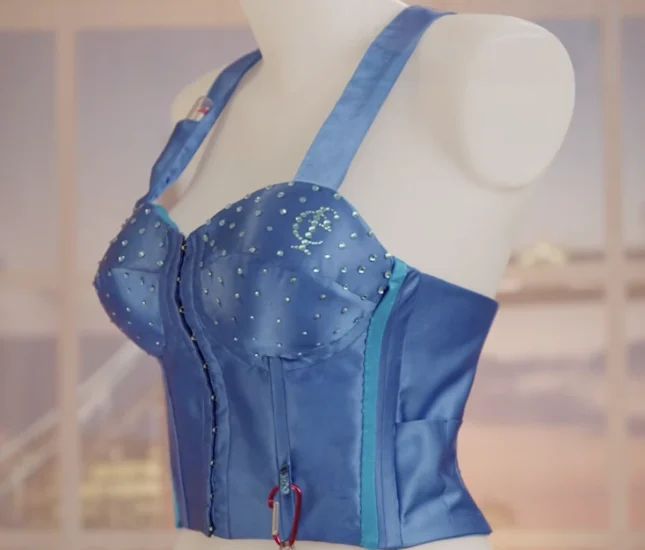
A wine brand built its 2026 flavor launch around a bra. Not as a background prop, but as the entire premise: Echo Falls, the UK wine label owned by drinks group Vinarchy, launched its new Blue Raspberry flavor by unveiling the “Carry-All,” a bra top with built-in cup inserts that hold a chilled 125ml serve of wine on one side and water on the other, alongside space for a phone, keys, and lip gloss. The reveal came wrapped in a spoof shopping-channel film, EFTV, starring TikTok personality GK Barry and real-life QVC presenter Sarah Searle.
The premise sounds like a punchline, and that’s precisely the point worth studying. In an advertising landscape where alcohol brands compete for a fragment of attention on a scrolling feed, Echo Falls chose to sell an object almost nobody will actually use over selling the beverage itself. That choice sits at the center of a real strategic question facing consumer brands in 2026: is manufacturing a talkable, absurd prop a more reliable path to cultural relevance than a conventional product ad, and if so, at what point does the joke start working against the brand it’s meant to promote? This piece argues that the Carry-All campaign succeeds specifically because it separates two jobs that ads usually try to do at once — capturing attention and communicating product truth — and assigns each job to a different performer, a structural choice with real grounding in advertising research on humor and credibility.
What follows: the background on Echo Falls, its parent company Vinarchy, and the commercial pressure driving the stunt; a claim-by-claim breakdown of why the sincerity-versus-irreverence contrast works; a counterargument about whether the “handbag-free Gen Z drinker” premise is even accurate; and a comparison to how another beverage brand, Liquid Death, built a real commercial business on the same comedic-prop playbook.
Background and Context
Prop marketing, in the sense used here, refers to a promotional strategy where a brand creates a physical object whose primary function is generating conversation and media coverage rather than serving as a sellable product in its own right — distinct from conventional merchandise, which is typically produced at scale for direct sale. Spoof advertising describes ads that adopt the visual and structural conventions of a recognizable format (in this case, a televised shopping channel) while exaggerating or subverting that format’s usual content, relying on the audience’s familiarity with the original to generate the comedic effect.
The commercial backdrop matters. Echo Falls is owned by Vinarchy, a wine conglomerate formed in April 2025 when Accolade Wines merged with Pernod Ricard’s international wine division, bringing together brands including Hardys, Jam Shed, Campo Viejo, and Jacob’s Creek under one roof (Just Drinks, 2025). Vinarchy’s marketing director for Europe, Tom Smith, has been explicit about the underlying problem the Carry-All is designed to solve: “shoppers often see wine as traditional, and instead turn to spirits-based RTDs or ciders for flavour and fun” (Just Drinks, 2025). That statement came attached to an earlier 2025 move, the launch of a canned Echo Falls RTD spritz aimed at the same younger drinker the Carry-All campaign targets — meaning Blue Raspberry and its bra are the second act in a deliberate, multi-step attempt to reposition a legacy wine brand for a demographic that associates wine with formality rather than fun. The wider industry is making the same bet: wine major Gallo acquired the Gen Z-focused brand Whiny Baby in the same period, part of an industry-wide scramble as legacy wine producers look for a foothold with younger drinkers.
Core Analysis
The Sincerity Gap Is the Joke’s Engine
Claim: The campaign’s comedic effectiveness depends specifically on pairing an irreverent performer with a straight, sincere one, rather than having both performers play the concept for laughs.
Evidence: In EFTV, GK Barry — a TikTok personality and host of the Saving Grace podcast, with a following in the millions across TikTok, Instagram, and YouTube — plays the exaggerated, self-aware host, while Sarah Searle, an established QVC presenter, delivers the Carry-All’s feature demonstrations with the same unwavering conviction she would bring to an actual televised product segment. Academic research on humor in advertising offers a specific reason this pairing works better than uniform comedy: studies on humorous versus serious advertising tone have found that serious-toned delivery can outperform humorous delivery on measures like purchase intent and perceived credibility, even while humor reliably boosts recall and word-of-mouth (research summarized in The Effectiveness of Humor in Advertising: Analysis from an International Scope, 2019).
Interpretation: Rather than choosing between the recall benefits of humor and the credibility benefits of sincerity, the two-presenter structure lets Echo Falls capture both simultaneously — GK Barry’s irreverence drives shareability, while Searle’s straight-faced delivery does the work a “serious” ad tone is shown to do in the research: signal credibility and product legitimacy inside the same sixty seconds of footage.
Limitation: The underlying humor-in-advertising research is drawn from a range of ad formats and product categories tested largely outside the short-form social video context this campaign lives in; it’s a reasonable analogy, not a direct empirical test of this specific execution’s actual purchase-intent lift, which hasn’t been published.
A Real Behavior, Exaggerated Into a Prop
Claim: The Carry-All works commercially as an attention device because it exaggerates a documented, specific consumer behavior rather than inventing a problem from nothing.
Evidence: Echo Falls commissioned research finding that 28% of women aged 18 to 29 in the UK now choose to go out without a handbag, part of a broader habit of tucking phones, cards, or cash into clothing when carrying a bag feels impractical on a night out. The Carry-All’s design directly literalizes that behavior — cup inserts for drink and water, storage for keys and lip gloss — pushing a real, low-key habit into a version so complete it becomes absurd.
Interpretation: Grounding an absurd prop in a specific, citable behavioral statistic gives the joke a foothold beyond pure novelty: viewers who exhibit or recognize the underlying handbag-free habit have a personal reason to engage with and share the content, beyond finding it simply funny. That’s a different mechanism than shock-value stunts built on no real observed behavior, and it likely extends the campaign’s shelf life in conversation.
Limitation: A single brand-commissioned statistic, without a published independent methodology, should be treated as a marketing data point rather than a rigorously validated behavioral finding; it’s plausible but not independently verified here.
Is the “Handbag-Free, Sober-Curious” Gen Z Premise Even Accurate?
A skeptical reading of this campaign — and of youth-targeted alcohol marketing generally — starts with the demand assumption underneath it. The dominant industry narrative through the early 2020s held that Gen Z was drinking meaningfully less than prior generations: roughly a third of 18-to-24-year-olds in the UK report not drinking alcohol at all, and about 17.5 million Britons, some 29% of the adult population, took part in Dry January 2026. On that reading, comedic, culturally fluent marketing like the Carry-All campaign is a defensive maneuver — a wine brand working unusually hard to win attention from a demographic actively drifting away from the category.
New research complicates that picture considerably. IWSR consumer research released in July 2026 found that Gen Z now drinks at almost exactly the same rate as the wider adult population, challenging what the report characterizes as one of the drinks industry’s most persistent assumptions (The Drinks Business, July 2026). If that finding holds up, the strategic story shifts: Echo Falls isn’t necessarily fighting to reverse a genuine generational retreat from alcohol so much as competing for share of a still-sizable young-drinker market against RTDs, ciders, and spirits-based options that have simply out-marketed wine on “flavour and fun,” in Vinarchy’s own words. Either reading supports the decision to invest in a culturally fluent stunt; they differ on whether the underlying task is demand creation or demand capture, a distinction that matters for how a marketing student should evaluate the campaign’s actual commercial ambition.
Cross-Sector Comparison: The Prop-Marketing Playbook, Tested at Scale
Echo Falls isn’t the first beverage brand to bet that an absurd branded object can outperform a conventional product ad, and a useful comparison sits in the same broad category. Liquid Death, the canned water company, built its identity almost entirely around comedic, rebellious branding and absurd merchandise — skateboards painted with a few drops of professional skater Tony Hawk’s blood, “severed head” pomade-branded car sunshades, and a members-only “Country Club” loyalty tier — reaching a $1.4 billion valuation and $263 million in 2023 revenue, a 139% year-over-year increase, with distribution in more than 133,000 stores.
The comparison is instructive on both sides. Liquid Death demonstrates that comedic prop and merchandise marketing can convert into durable commercial scale in a beverage category, not just a single viral news cycle — evidence against the objection that stunts like the Carry-All are inherently disposable attention plays with no lasting brand value. But Liquid Death also built that scale over several years of sustained, repeated stunts and merchandise drops, not a single campaign moment; one comedic bra does not, by itself, establish the kind of ongoing content engine Liquid Death runs. Whether Echo Falls treats the Carry-All as a one-off flavor launch or the opening move in a sustained comedic content strategy will likely determine which comparison — a memorable but isolated stunt, or the first step toward a Liquid Death-style brand identity — turns out to be the more accurate one.
Data and Evidence Layer
Methodology note: This analysis synthesizes trade press coverage of the Echo Falls campaign (Verge Magazine, regional UK news via the Enfield Independent and Times and Star, and Just Drinks industry reporting) with peer-reviewed and industry research on humor in advertising and Gen Z drinking behavior. Because the underlying campaign performance data — video views, engagement rate, or sales lift specific to Blue Raspberry — has not been published by Echo Falls or Vinarchy at the time of writing, this piece relies on qualitative campaign description and comparative industry benchmarks (such as the Liquid Death case) rather than first-party campaign metrics, a limitation flagged explicitly here rather than papered over with unsourced numbers.
| Campaign element | Detail | Source |
|---|---|---|
| Product hook | Blue Raspberry flavor launch | Echo Falls / Vinarchy |
| Prop | “Carry-All” bra with 125ml wine + water cup inserts | Verge Magazine, 2026 |
| Format | EFTV, spoof shopping-channel film | Campaign coverage |
| Irreverent performer | GK Barry (TikTok, Saving Grace podcast) | Enfield Independent, 2026 |
| Sincere performer | Sarah Searle (QVC presenter) | Campaign coverage |
| Behavioral hook | 28% of UK women 18–29 go out without a handbag | Echo Falls-commissioned research |
| Parent strategy context | Echo Falls RTD spritz launched Oct 2025 targeting Gen Z | Just Drinks, 2025 |
Implications
The clearest practical implication for marketers is that the attention-getting device and the credibility-establishing device don’t need to be the same performer or the same tone — splitting those jobs between an irreverent host and a sincere one is a repeatable structural choice, not a one-off creative accident, and it’s consistent with what humor-in-advertising research already suggests about the limits of comedy alone. For alcohol and beverage brands specifically, the Echo Falls case argues that grounding an absurd prop in a real, specific, citable consumer behavior (the handbag-free statistic) gives a stunt more durability in conversation than shock value alone. For brand strategists evaluating whether this kind of campaign is worth the investment, the Liquid Death comparison offers a clear, quotable benchmark: comedic prop marketing can scale into real commercial value, but only when treated as a sustained content strategy rather than a single campaign moment.
Counterpoints and Limitations
This analysis has clear boundaries. No published sales, video view, or engagement data for the EFTV campaign or Blue Raspberry flavor specifically was available at the time of writing, so claims about the campaign’s effectiveness rest on qualitative creative analysis and comparative industry benchmarks, not first-party performance metrics — readers should treat the “why it works” argument as a structural and theoretical case, not a proven ROI outcome. The 28% handbag-free statistic is brand-commissioned research without an independently published methodology, and should be read with that caveat. The Gen Z drinking-behavior counterargument section presents genuinely conflicting research (the “sober curious” narrative versus IWSR’s 2026 moderation-myth finding); this piece does not resolve which reading is more accurate, because the underlying data itself is contested within the drinks industry. Finally, the Liquid Death comparison is illustrative rather than a controlled analog — canned water and flavored wine sit in different competitive categories with different regulatory constraints (particularly around alcohol marketing to younger audiences), and a comedic strategy that works for one may not transfer cleanly to the other.
Conclusion
The evidence supports a specific claim: the Carry-All campaign works because it deliberately separates two functions that advertising often conflates — using GK Barry’s irreverence to earn attention and Sarah Searle’s sincerity to carry credibility — while grounding its central joke in a real, if brand-reported, consumer behavior rather than pure shock value. That structural choice has real support in advertising research on humor’s mixed relationship with purchase intent, even though this specific campaign’s commercial results remain unpublished and therefore unproven.
The open question is whether Echo Falls treats this as a single memorable moment or the start of a sustained comedic identity in the mold of Liquid Death — and whether the contested question of how much Gen Z is actually drinking will make that investment look prescient or overcautious by the time Blue Raspberry’s second summer on shelf arrives.
FAQ
What is the Echo Falls Carry-All?
The Carry-All is a limited-edition bra top created by wine brand Echo Falls, featuring built-in cup inserts that hold a chilled 125ml serve of its Blue Raspberry wine on one side and water on the other, plus space for a phone, keys, and lip gloss, designed to promote the flavor’s launch.
Who stars in the Echo Falls EFTV campaign?
The campaign film features TikTok personality and Saving Grace podcast host GK Barry playing an exaggerated shopping-channel presenter, alongside real-life QVC presenter Sarah Searle, who demonstrates the Carry-All’s features with total sincerity.
Who owns Echo Falls wine?
Echo Falls is owned by Vinarchy, a wine conglomerate formed in April 2025 from the merger of Accolade Wines and Pernod Ricard’s international wine division, which also owns brands including Hardys, Jam Shed, and Campo Viejo.
Is Gen Z actually drinking less alcohol?
The evidence is contested. Roughly a third of UK 18-to-24-year-olds report not drinking at all, and participation in Dry January has grown, but IWSR consumer research released in July 2026 found Gen Z now drinks at almost the same rate as the general adult population, challenging the industry’s long-standing “moderation” narrative.