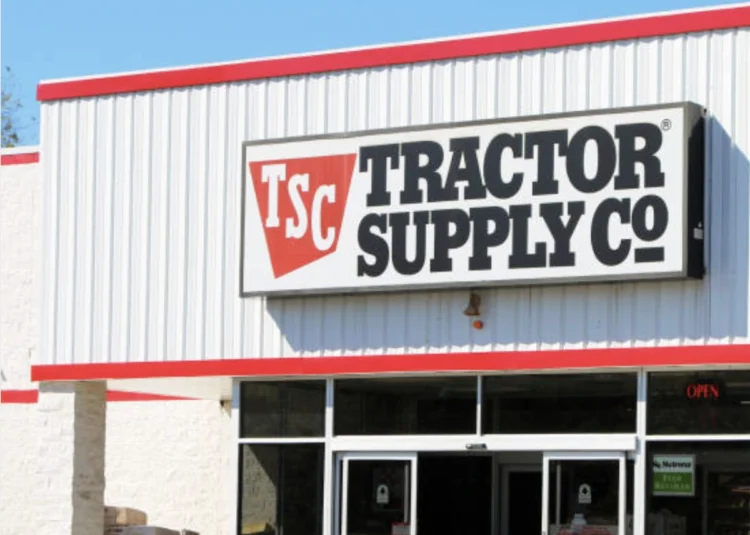
A company can grow its sales and still be having a rough quarter. That is exactly the tension inside Tractor Supply Company’s (NASDAQ: TSCO) latest earnings report: net sales climbed 2.3% year-over-year, yet adjusted net income slipped 1.5%, squeezed by higher expenses. Alongside those results, the company announced it will close 75 of its 209 Petsense by Tractor Supply pet stores. Together, these two facts tell a story that goes well beyond one retailer’s quarterly report. They illustrate a pattern every business owner eventually encounters: rising revenue does not automatically translate into rising profit, and sometimes the right response is to shrink deliberately rather than keep growing indefinitely.
This article unpacks why Tractor Supply’s sales and profit numbers diverged, what expenses drove that gap, and why closing a third of one of its retail chains was the company’s answer.
The Core Tension: Growth in Sales, Decline in Profit
In its second quarter of fiscal 2026, Tractor Supply reported net sales of $4.54 billion, up 2.3% from $4.44 billion in the same period a year earlier. That growth came primarily from new store openings rather than stronger performance at existing locations, since comparable store sales, a measure of sales at stores open for at least a year, actually fell 1.5%. Unfavorable May weather and softer spending on big-ticket, discretionary items were cited as key headwinds during the quarter’s most important month.
Despite the higher top-line number, adjusted net income, which strips out one-time charges to reflect ongoing operating performance, declined 1.5% to $423.5 million. Reported net income fell even further, down 16.1% to $360.7 million, reflecting one-time impairment and acquisition-related charges layered on top of the underlying cost pressure. In short: more revenue came in, but even more was consumed by rising expenses before it reached the bottom line.
Where the Extra Expenses Came From
The gap between sales growth and profit decline did not appear from nowhere. Several specific cost pressures were at work during the quarter:
- Freight and distribution costs: Elevated freight expenses weighed on gross margin, even as the company managed product costs carefully.
- Petsense restructuring charges: The decision to close 75 underperforming Petsense stores triggered approximately $71.7 million in impairment and other charges, including a $5.9 million inventory write-down.
- VIP Petcare acquisition costs: The recently completed acquisition of veterinary services provider VIP Petcare added roughly $9.5 million in related expenses during the quarter.
- SG&A deleverage: Selling, general, and administrative expenses grew faster than sales, contributing to a compression in adjusted operating margin to 12.1% from 13.0% a year earlier, a decline of roughly 94 basis points.
None of these costs are unusual in isolation. What made the quarter notable is that several of them landed at once, turning a top-line growth story into a bottom-line disappointment.
Why Tractor Supply Chose to Close Stores Rather Than Just Absorb the Cost
Faced with rising expenses and a chain of underperforming locations, Tractor Supply’s leadership opted for a targeted fix rather than a company-wide cost-cutting exercise. According to CFO Kurt Barton, the 75 Petsense stores marked for closure were generating negative four-wall cash flow, meaning each of those individual stores was losing cash on its own, independent of any corporate overhead allocation.
CEO Hal Lawton described the move as a way to improve returns, simplify the business, and redirect capital toward higher-growth, higher-return opportunities, including store remodels, the company’s Final Mile delivery initiative, and the broader “pet ecosystem” being built around VIP Petcare. This approach mirrors a broader business principle worth understanding in more depth through how cash flow, free cash flow, and the cash flow statement support informed business decisions: a business does not need to grow every part of itself equally, and identifying which parts are consuming rather than generating cash is often the first step toward better decisions.
What the Broader Guidance Cut Signals
Tractor Supply did not stop at closing stores. It also lowered its full-year fiscal 2026 outlook, now projecting net sales growth of 2.5% to 3.5%, comparable store sales between down 1% and flat, and adjusted diluted EPS of $1.90 to $2.00, all reduced from earlier expectations. The company withdrew the long-term financial framework it had introduced at its December 2024 Investor Day, with an updated version expected alongside fourth-quarter results.
This kind of guidance reset often reflects more than one bad quarter. It typically signals that management expects the current pressures, softer discretionary spending, elevated freight costs, and integration costs from recent acquisitions, to persist for at least the near term, rather than being a one-time blip.
A Familiar Pattern Across Retail
Tractor Supply’s situation fits into a broader retail pattern in which companies scale back underperforming segments rather than continue funding them indefinitely. Macy’s has closed a portion of its namesake stores as part of an ongoing turnaround. Saks Global, now operating as Exemplar Luxury Group, closed roughly two dozen Saks Fifth Avenue and Neiman Marcus locations along with nearly its entire Saks Off 5th chain during its bankruptcy restructuring. In each case, a company facing cost pressure or shifting consumer demand chose to shrink strategically rather than let underperforming units erode overall profitability. This same discipline shows up in how businesses evaluate their own worth, a concept explored in how to price a business for sale, where buyers look past revenue toward the profitability and cash flow that revenue actually converts into.
What This Means for Small and Mid-Sized Businesses
Few small business owners operate 209-location retail chains, but the underlying lesson scales down easily. A business can be adding customers, opening new locations, or launching new products, and still see profit shrink if costs are rising faster than revenue, or if a specific product line, service, or location is quietly losing money. Tractor Supply’s response, closing the 75 stores with the worst cash flow rather than cutting evenly across the entire company, is a useful model: targeted cuts based on actual performance data tend to be more effective than blanket cost-cutting.
This is closely related to the discipline behind evaluating return on investment when deciding where to direct limited capital, since the same logic that determines whether 75 stores deserve continued investment applies just as well to a single product line, marketing channel, or service offering in a smaller business.
Common Misconceptions About This Type of News
- “If sales are up, the company must be doing well.” As this quarter shows, sales growth driven by new locations can mask weakening performance and rising costs elsewhere in the business.
- “Closing stores is only ever a sign of trouble.” In this case, the closures are a proactive response to identified underperformance, not a reaction to an existential crisis; the company’s core Tractor Supply stores continue to open new locations.
- “A 1.5% decline in adjusted net income is not significant.” In dollar terms, that decline represents millions in reduced profitability, and it was significant enough to accompany a full-year guidance cut.
- “Higher expenses always mean poor management.” Some of the added costs, such as acquisition-related expenses for VIP Petcare, reflect deliberate investment in future growth rather than mismanagement.
Frequently Asked Questions
1. Why did Tractor Supply’s profit fall even though sales increased?
Higher expenses, including freight costs, Petsense restructuring charges, and VIP Petcare acquisition costs, grew faster than sales, causing adjusted net income to decline 1.5% even as net sales rose 2.3%.
2. How many Petsense stores are closing, and how many will remain?
Tractor Supply will close 75 of its 209 Petsense stores, leaving approximately 125 locations operating across 23 states.
3. What specific charges are tied to the Petsense closures?
The closures are expected to result in about $71.7 million in impairment and other charges, including a $5.9 million inventory write-down.
4. Did Tractor Supply lower its full-year guidance?
Yes. The company reduced its fiscal 2026 outlook for net sales growth, comparable store sales, and adjusted earnings per share, and withdrew its prior long-term financial framework.
5. What is four-wall cash flow, and why did it matter in this decision?
Four-wall cash flow measures the cash a single store generates or consumes on its own, excluding corporate overhead. The Petsense stores being closed were identified as having negative four-wall cash flow.
6. Is Tractor Supply’s core namesake retail business struggling too?
Not based on the reported results. The core Tractor Supply store business continues to open new locations, though at a slightly reduced pace, while the closures are focused specifically on the smaller Petsense chain.
7. What role does the VIP Petcare acquisition play in this story?
VIP Petcare, a veterinary services provider acquired in 2026, added acquisition-related costs during the quarter but is central to Tractor Supply’s strategy of building a broader pet ecosystem alongside its retail stores.
8. How should investors interpret a quarter where sales rise but adjusted profit falls?
It generally signals that cost growth is outpacing revenue growth, and it is worth examining comparable store sales and margin trends rather than relying on the headline revenue figure alone.
9. Is closing underperforming stores a common retail strategy?
Yes. Retailers across the industry, including Macy’s and the former Saks Global, have used targeted store closures to improve overall profitability and focus resources on stronger-performing locations.
10. What can smaller businesses learn from Tractor Supply’s approach?
The key takeaway is to make cuts based on actual performance data at the unit or product level, rather than applying uniform cost-cutting across an entire business regardless of individual performance.
Conclusion
Tractor Supply’s second-quarter fiscal 2026 results are a reminder that a single revenue figure rarely tells the full financial story. Net sales rose 2.3%, but adjusted net income fell 1.5% as higher freight, restructuring, and acquisition costs outpaced that growth. Rather than absorbing the pressure company-wide, Tractor Supply responded with a targeted decision: closing 75 Petsense stores identified as cash-negative, while lowering guidance to reflect a more cautious outlook. For businesses of any size, the underlying lesson holds: when expenses grow faster than revenue, the answer is rarely to keep doing the same thing at a larger scale. It is to identify precisely where the cash is being lost and act on that information directly.
Key Takeaways
- Tractor Supply’s net sales rose 2.3% to $4.54 billion, but adjusted net income fell 1.5% to $423.5 million due to higher expenses.
- Freight costs, Petsense restructuring charges, and VIP Petcare acquisition costs were the main drivers of the profit decline.
- The company will close 75 of 209 Petsense stores after identifying negative four-wall cash flow at those locations.
- Tractor Supply lowered its fiscal 2026 guidance and withdrew its prior long-term financial framework.
- The core Tractor Supply retail business continues to grow; the closures are targeted specifically at the smaller Petsense chain.
Further Reading
- Understanding Cash Flow, Free Cash Flow, and the Cash Flow Statement for Informed Decisions —
Why continue reading: Explains the cash flow concepts that directly informed Tractor Supply’s decision to close its cash-negative Petsense stores. - Return on Investment (ROI): What It Is, How to Calculate It, and What Makes a Good ROI —
Why continue reading: Offers the framework for evaluating whether capital redirected away from closed stores is being deployed effectively. - How to Price a Business for Sale: The Complete Guide —
Why continue reading: Shows how the same profitability and cash flow lens used to evaluate Tractor Supply’s stores applies when valuing an entire business.
Comparison Tables
Table 1: Cost Drivers Behind the Profit Decline
| Cost Driver | Approximate Impact | Nature of Expense |
|---|---|---|
| Petsense restructuring charges | $71.7 million | One-time, tied to store closures |
| VIP Petcare acquisition costs | $9.5 million | One-time, tied to acquisition integration |
| Freight and distribution costs | Margin pressure (unspecified dollar amount) | Ongoing operating expense |
| SG&A growth | Contributed to ~94 bps margin compression | Ongoing operating expense |
Table 2: Fiscal 2026 Guidance, Before vs. After the Update
| Metric | Prior Guidance | Updated Guidance |
|---|---|---|
| Net sales growth | Higher initial target | 2.5% to 3.5% |
| Comparable store sales | Positive growth expected | Down 1% to flat |
| Adjusted diluted EPS | Higher initial target | $1.90 to $2.00 |
| Long-term framework | In effect since December 2024 | Withdrawn; update expected with Q4 results |