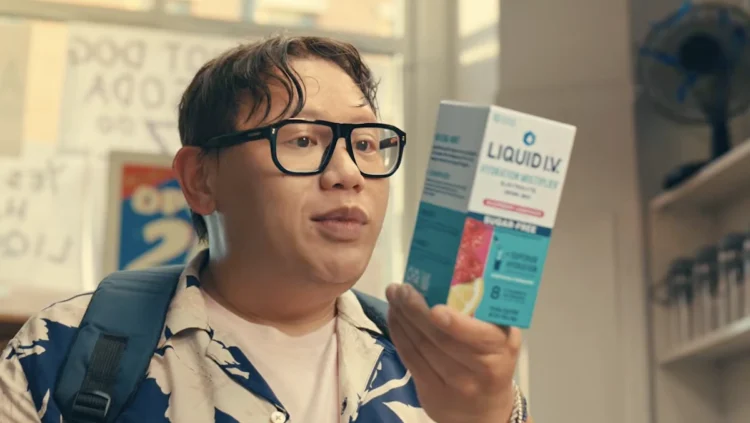
Spider-Man never gets a close-up in Liquid I.V.’s newest ad. He swings through the background of nearly every shot, disarming muggers and catching falling construction debris, while the camera stays locked on his oblivious best friend, Ned Leeds, wandering down a sweltering New York sidewalk with his headphones in. Ned never notices. The ad, titled “Your Friendly Neighborhood Hydration Brand,” is Liquid I.V.’s official tie-in with Sony’s Spider-Man: Brand New Day, and it makes a strategic choice most studio-brand partnerships don’t: sidelining the franchise’s most bankable asset to build the entire joke around a supporting character audiences barely remember from the last film.
That choice is worth examining closely, because it runs against the obvious playbook. A movie tie-in’s job is usually to borrow as much of a franchise’s star power as licensing will allow; Liquid I.V. had access to Spider-Man himself and largely declined to use him as the ad’s subject. This piece argues that the decision works precisely because it converts a real plot detail from the Spider-Man franchise — that Ned’s memory of his best friend was erased at the end of the previous film — into the ad’s entire comedic structure, rewarding franchise-literate viewers while still landing as a simple gag for everyone else. That’s a more sophisticated use of intellectual property than slapping a logo on a poster, and it says something broader about how tie-in marketing is evolving as audiences grow fatigued with franchise crossovers that feel bolted on rather than built in.
What follows: the background on Liquid I.V.’s entertainment marketing strategy and the film continuity the ad depends on, a claim-by-claim breakdown of why the sidekick-centered structure works, a counterargument about whether sidelining the actual superhero risks the campaign’s core message getting lost, and a comparison with two other brands — Samsung and Scoot — running their own campaigns around the same film release.
Background and Context
Dramatic irony, the literary and screenwriting device at the center of this campaign, occurs when the audience holds information that a character within the story does not, producing tension or comedy from the gap between what viewers understand and what the character believes. It’s a device with a long pedigree in film and theater, and its use in advertising is less common precisely because most ads don’t have a story complex enough to support it in thirty seconds.
The ad’s premise isn’t arbitrary — it’s a direct extension of Spider-Man‘s own recent plot. Spider-Man: No Way Home ended with a spell that erased the world’s memory of Peter Parker as Spider-Man, including the memories of his closest friends, Ned Leeds among them. Brand New Day, the fourth film in this incarnation of the franchise, picks up in that altered reality. Liquid I.V.’s ad, starring Jacob Batalon reprising his role as Ned, isn’t inventing an “oblivious sidekick” trope from scratch — it’s dramatizing an actual consequence of the franchise’s own continuity: Ned no longer knows his best friend is Spider-Man, so of course he doesn’t notice being saved by him (Adweek, 2026).
The commercial context matters too. Liquid I.V. was acquired by Unilever in 2020 for roughly $200 million when the brand was doing north of $100 million in annual revenue; it has since quadrupled in size to become the largest brand in Unilever’s €1.9 billion Health & Wellbeing Collective and the top-selling powdered hydration brand in the US, now sold across 15 global markets (Unilever, 2024). The Spider-Man tie-in is described as Liquid I.V.’s largest entertainment collaboration to date, extending beyond the TV spot into in-film product placement, two limited-edition co-branded flavors — Hydration Multiplier Arctic Raspberry and Sugar-Free Raspberry Lemonade — and a planned fan experience tied to the film’s July 31, 2026 release, which is tracking for a US opening between $180 million and $190 million according to Deadline’s estimates.
Core Analysis
The Joke Only Works Because the Audience Knows More Than Ned Does
Claim: The ad’s comedic and commercial effectiveness depends specifically on the audience holding information Ned lacks, a structure lifted directly from dramatic irony rather than conventional advertising gag construction.
Evidence: Throughout the thirty-second spot, viewers watch Spider-Man intervene in a string of near-disasters — a pair of masked thugs, falling construction equipment — each staged clearly enough for the audience to register the save, while Ned remains visually absorbed in his headphones and the heat. He arrives at a corner store, recites Liquid I.V.’s hydration benefits, drinks the product, and declares himself “ready for a brand new day,” with no acknowledgment that he was ever in danger (MediaPost, 2026).
Interpretation: A generic “unaware bystander” gag would work as simple slapstick, but this version carries extra weight for anyone who saw No Way Home: the audience isn’t just amused that Ned doesn’t notice, they understand precisely why he can’t — his memory of Peter’s secret identity was erased within the story itself. That double layer, comedy for casual viewers and continuity payoff for franchise-literate ones, is a more efficient use of thirty seconds of licensed IP than a straightforward cameo would have been, because it makes the brand’s ad feel like a genuine extension of the film’s story rather than a separate commercial interruption.
Limitation: This interpretation assumes a meaningful share of the ad’s audience has seen or remembers the plot of No Way Home, released years earlier; viewers unfamiliar with that film still get a coherent, funny ad, but they receive it as generic slapstick rather than the layered continuity joke it’s built to be, meaning the ad’s “smartest” quality is invisible to a large share of its actual reach.
Selling Hydration Through a Problem the Audience Already Recognizes
Claim: The ad’s product message lands because it grounds Liquid I.V.’s function — hydration relief — in a physically legible, universally recognizable discomfort (a brutal NYC heat wave) rather than an abstract health claim.
Evidence: The spot is explicit about its setting: Ned is visibly overheated, sweating, and searching for relief across the full length of the ad before he ever reaches the product. Coverage of the campaign’s release timing notes it arrived as New York was experiencing an actual heat wave, reinforcing the ad’s premise with real, contemporaneous weather rather than a staged or seasonally arbitrary backdrop.
Interpretation: Functional hydration products face a harder education problem than most beverages — the pitch requires explaining why water alone isn’t enough, a claim that can come across as unnecessary if not visually motivated. By building thirty seconds of visible physical discomfort before the product appears, the ad does the persuasion work of “you need more than water” without a single line of dialogue making that argument directly.
Limitation: This structure is only as strong as the discomfort is legible to the viewer; a heat-wave narrative travels well as a national TV and digital placement but is a weaker fit for markets or seasons where extreme heat isn’t a shared, immediate experience, a real constraint on how far this specific creative concept can be reused outside a US summer context.
Counterargument: Does Hiding the Hero Undersell the Franchise Connection?
A fair objection to this campaign’s structure is that it may be too clever for its own commercial good. Movie tie-in advertising exists primarily to transfer a franchise’s built-in audience excitement onto a partner brand, and the most direct way to do that is visible proximity to the franchise’s biggest asset — in this case, Spider-Man himself, or the actor most associated with him. By keeping Spider-Man in the background and centering a supporting character many casual viewers won’t immediately place, Liquid I.V. risks a version of its audience scrolling past the ad without registering that it’s a Spider-Man tie-in at all, undercutting the exact borrowed excitement the partnership was designed to capture.
There’s also a broader industry pattern that sharpens this concern. Movie marketing research on brand tie-ins has documented growing “collaboration fatigue” as blockbuster releases sign an increasing number of promotional partners; when scale substitutes for strategy, audiences report tuning out, and the strongest partnerships are consistently found to be defined by alignment and shared tone rather than sheer visibility. Brand New Day is not a single-partner promotion — Samsung and the airline Scoot are running simultaneous, separate campaigns tied to the same release, meaning Liquid I.V.’s ad is competing for the audience’s limited “which brand is doing the Spider-Man thing” recall against at least two other advertisers making the same pitch in the same window. Academic research on brand alliances further suggests audience attitudes toward one partner in a multi-brand promotional cluster can spill over onto how they perceive the others — meaning a weaker or more forgettable partner campaign in the same film’s promotional slate could, in principle, dilute Liquid I.V.’s own recall even if its individual creative execution is strong.
Cross-Brand Comparison: Three Companies, One Film, Three Different Bets
Liquid I.V. isn’t alone in betting on Brand New Day, and the contrast with its fellow partners clarifies what’s distinctive about the Ned Leeds strategy. Samsung also signed Jacob Batalon as a Galaxy brand ambassador for a separate campaign, directed by Marvel alum Kasra Farahani, that puts a Galaxy phone through “the wear and tear of superhero life” using actual footage from the film alongside new branded content (Samsung Newsroom, 2026) — notably, Samsung also chose Ned Leeds as its human face rather than leading with Spider-Man directly, suggesting the “relatable sidekick, not the hero” approach may be a deliberate, coordinated brand-safety choice across partners rather than a one-off creative accident unique to Liquid I.V. Scoot, the Singapore-based budget carrier and the exclusive Asia-Pacific airline partner for the release, took a structurally different approach entirely, transforming multiple points of the actual passenger journey — rather than a single ad spot — into branded extensions of the Spider-Man universe.
The comparison suggests at least two viable strategies for franchise tie-in marketing operating at once within the same release: narrative-embedded storytelling that borrows a specific plot detail (Liquid I.V. and, to a degree, Samsung), and environmental, experience-based branding that borrows the franchise’s aesthetic across a physical journey (Scoot). Both are legitimate answers to the “collaboration fatigue” problem raised above, since both aim for depth of integration over sheer logo visibility — but they remain three separate messages competing for the same finite pool of moviegoer attention in the weeks before release, and no public data yet indicates which, if any, achieved superior recall.
Data and Evidence Layer
Methodology note: This analysis draws on trade and entertainment press coverage (Adweek, MediaPost, Marketing Dive, Samsung Newsroom) published around the campaign’s July 2026 launch, cross-referenced against publicly reported plot details from Spider-Man: No Way Home and Brand New Day. As with most pre-release movie tie-in campaigns, no independent audience recall, engagement, or sales-lift data has been published for any of the three partner campaigns discussed here at the time of writing; the comparison below documents creative and strategic approach, not measured performance.
| Brand | Featured talent | Format | Core mechanic |
|---|---|---|---|
| Liquid I.V. | Jacob Batalon as Ned Leeds | 30-second TV/digital spot, “Your Friendly Neighborhood Hydration Brand” | Dramatic irony built on No Way Home memory-erasure plot |
| Samsung | Jacob Batalon as Ned Leeds (Galaxy ambassador) | Cinematic spot blending film footage with branded content | Product durability shown through in-film superhero action |
| Scoot | Film branding, no lead actor campaign identified | Multi-touchpoint passenger journey redesign | Environmental, experience-based franchise theming |
Two co-branded Liquid I.V. flavors, Hydration Multiplier Arctic Raspberry and Sugar-Free Raspberry Lemonade, support the campaign as limited-edition retail products, giving the tie-in a purchasable extension beyond the ad itself — a detail worth noting for anyone assessing whether this campaign is built to drive trackable retail lift or brand awareness alone.
Implications
The practical implication for marketers evaluating franchise tie-ins is that borrowing a specific, citable plot detail from the source material can outperform generic proximity to a franchise’s biggest star, because it gives franchise-literate audiences a reason to feel the ad was made specifically for them rather than licensed after the fact. That’s a repeatable creative principle, not a fluke specific to Spider-Man: any brand negotiating a franchise partnership can ask whether its creative concept depends on the license only for imagery, or whether it’s actually dramatizing something true within that franchise’s story. For brand strategists worried about “collaboration fatigue” diluting a tie-in’s impact, the comparison across Liquid I.V., Samsung, and Scoot is instructive and quotable: depth of narrative or experiential integration, not visibility of the biggest star, is what separates a tie-in that feels bespoke from one that reads as a generic promotional slot — even when several such partnerships are running for the same release at once.
Counterpoints and Limitations
This analysis has clear boundaries. No independently published audience recall, brand lift, or sales data exists yet for the Liquid I.V. campaign or its Samsung and Scoot counterparts, so every claim about relative effectiveness here is a structural and creative argument, not a proven performance outcome — a limitation consistent with evaluating any pre-release movie marketing campaign. The argument that franchise continuity knowledge (specifically, familiarity with No Way Home‘s memory-erasure ending) deepens the ad’s impact is a reasonable inference from the ad’s construction, not a measured finding about actual audience comprehension or recall, and this piece has no data on what share of viewers actually made that connection. The “collaboration fatigue” research cited in the counterargument section describes a general industry pattern documented across many films and brand partnerships; it is not a study of this specific film’s promotional slate, and this piece does not have data confirming that fatigue is actually suppressing recall for Brand New Day‘s partners specifically. Finally, this piece focuses on the creative and strategic structure of the campaign and does not assess Liquid I.V.’s broader hydration-category competitive position against rivals like Gatorade, Prime, or LMNT, which sit outside this campaign’s scope.
Conclusion
The evidence supports a specific claim: Liquid I.V.’s decision to center Ned Leeds rather than Spider-Man works because the joke is built on a real, specific detail of the franchise’s own continuity rather than a generic sidekick trope, giving the ad a layer of reward for franchise-literate viewers while still functioning as straightforward, legible comedy for everyone else. That’s a more sophisticated use of a costly licensing deal than simple star proximity would have been — though whether it actually outperforms a more conventional approach, and whether it cuts through the “collaboration fatigue” created by running alongside Samsung’s and Scoot’s simultaneous campaigns for the same film, remains unmeasured and genuinely uncertain.
The open question worth watching once Brand New Day opens on July 31: will any of the three brand partners publish recall or sales-lift data that actually tests whether narrative-embedded tie-ins like Liquid I.V.’s outperform the more conventional star-forward or environmental approaches used by its fellow partners — or will this, like most movie tie-in marketing, remain a case study built on creative analysis rather than measured proof?
FAQ
Why does Liquid I.V.’s Spider-Man ad star Ned Leeds instead of Spider-Man?
The ad centers Ned Leeds (Jacob Batalon) because the joke depends on a real plot detail from Spider-Man: No Way Home, in which Ned’s memory of his best friend’s secret identity was erased. That makes Ned’s obliviousness to being repeatedly saved a continuity-consistent gag rather than a generic sidekick trope.
What is Liquid I.V.’s Spider-Man campaign called?
The campaign is titled “Your Friendly Neighborhood Hydration Brand,” a 30-second TV and digital spot created with agency Blue Raven and directed by Alen Petkovic, released ahead of Spider-Man: Brand New Day’s July 31, 2026 theatrical debut.
What other brands are partnering with Spider-Man: Brand New Day?
Samsung is running a separate Galaxy ambassador campaign also featuring Jacob Batalon as Ned Leeds, and Scoot, a Singapore-based budget airline, is the exclusive Asia-Pacific airline partner, redesigning multiple passenger touchpoints with Spider-Man theming.
Who owns Liquid I.V.?
Liquid I.V. has been owned by Unilever since a 2020 acquisition valued at roughly $200 million. It is now the largest brand in Unilever’s €1.9 billion Health & Wellbeing Collective and the top-selling powdered hydration brand in the US.