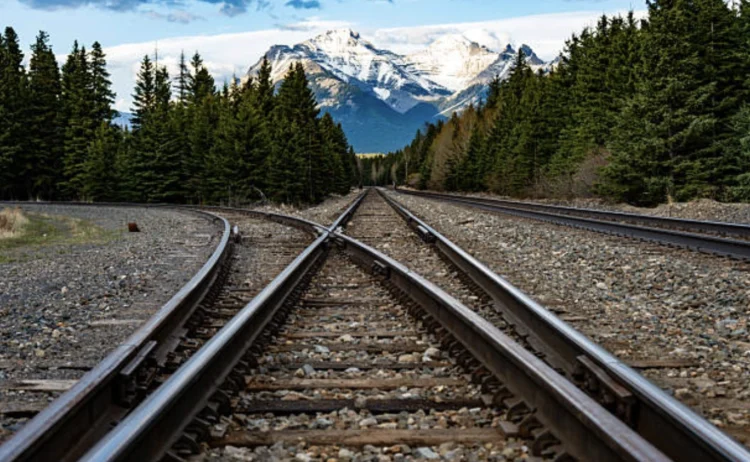
No Roads Lead to Churchill
There is exactly one way to reach Churchill, Manitoba by land: a 1,700-kilometre train journey from Winnipeg that takes roughly 45 hours, crossing boreal forest, prairie farmland and Arctic tundra before terminating at the shore of Hudson Bay. No highway connects Churchill to the rest of Canada. For the roughly 900 people who live there year-round, and the thousands of visitors who arrive each autumn hoping to see one of the estimated 1,000 polar bears that gather nearby, the train isn’t a novelty — it’s the only overland lifeline the town has.
That combination — genuine wildlife spectacle and genuine transportation necessity — is what makes this route unusual among wildlife-travel destinations. This piece traces the journey from Winnipeg to Churchill in sequence: the Indigenous communities the train passes through, the railway’s own recent history of being bought back into Indigenous ownership, and what actually happens once you reach a town that bills itself, with real justification, as the Polar Bear Capital of the World.
The Route and Why the Train Still Matters
The Winnipeg–Churchill train runs on Canadian National Railway track north to The Pas, where it transfers onto the Hudson Bay Railway for the remainder of the journey through Wabowden, Thompson (via a spur line), Gillam and Ilford before reaching Churchill on Hudson Bay. It operates twice weekly in each direction — northbound trains leave Winnipeg on Tuesdays and Sundays, arriving in Churchill roughly 45 hours later, while southbound service departs Churchill on Thursday and Saturday evenings.
Thompson is the last point on the route reachable by road; everything north of it depends entirely on the train for both passengers and freight. That single-track dependency has real consequences: because the line is shared with freight traffic and freight operators generally get right-of-way priority, passenger trains frequently wait — sometimes 10 minutes, sometimes closer to an hour — for freight trains to clear the single track, a built-in unpredictability train crews describe simply as “how it works.”
Winnipeg: Where the Journey — and a Longer History — Begins
Winnipeg, Manitoba’s capital, surpassed 850,000 residents in 2026 and now has the largest Indigenous population of any city in Canada. That demographic reality is visible on its walls: Winnipeg has more than 600 murals across the city, many reflecting Indigenous artists’ work. Cree artist Peatr Thomas, whose murals frequently depict animals from his home community, has described his subject choices as directly tied to subsistence and cultural memory — geese, in particular, which his family relied on for food and which he associates with the value of shared, rotating leadership: geese take turns leading their formation in flight, no single bird leading throughout, a structure Thomas has said reflects values he feels many communities have lost.
Winnipeg’s location itself carries deep history. The city sits at the confluence of the Red and Assiniboine Rivers, a site known as The Forks, which archaeological and oral evidence suggests has served as an Indigenous meeting place for at least 6,000 years — long used as a canoe travel hub and trading site before European contact. The city’s name derives from the Cree words win (muddy) and nipi (water), referencing the muddy waters beneath the rivers’ surface. A former Hudson’s Bay Company department store still stands in the city center — the company was established by the British in the 17th century specifically to control the regional fur trade, a history now widely acknowledged as a source of significant suffering for Indigenous communities, and one that Winnipeg’s contemporary Indigenous public art directly engages with rather than obscures. Fittingly, the Canadian Museum for Human Rights and the Wall of Hope now stand at The Forks, immediately beside the city’s main rail station.
Riding Mountain and the Red River Métis
South of the rail line, in Manitoba’s prairie and farmland belt, lies Riding Mountain National Park, home to a managed herd of roughly 35-40 plains bison in a 500-hectare enclosure — descendants of ten animals reintroduced from Elk Island National Park in the 1940s. Bison are a protected species in Canada; nationally, only around 2,200 plains bison and 11,000 wood bison currently roam free, a small population still vulnerable to habitat loss and disease despite decades of reintroduction efforts. For Manitoba’s Métis communities, seeing bison carries meaning well beyond wildlife viewing. Will Goodon, a Red River Métis representative based in Portage la Prairie, has described the experience of watching bison graze as a direct connection to ancestors who once hunted them by the hundreds in coordinated communal hunts, each participant assigned a specific role — an activity Métis oral history credits with helping form the community’s identity as a distinct people and, eventually, a nation.
The Métis themselves emerged from a specific historical pattern: French and Scottish fur traders marrying local Indigenous women, then frequently returning to Europe, leaving families that were subsequently excluded by both European and Indigenous communities around them. Rather than being absorbed into either group, these families began forming their own settlements, blending French and Scottish musical traditions — fiddle playing and dance — with Indigenous cultural influence audible beneath the surface. Hunting rights for Métis communities were not automatically preserved through this history; Goodon has described having to fight for recognized hunting rights through Canada’s Supreme Court, including being prosecuted himself for hunting on a lake his family had used for generations, before those rights were formally secured.
A Railway Owned by the Communities It Serves
Perhaps the most significant recent chapter in this route’s history has nothing to do with wildlife at all. In May 2017, severe flooding washed out the Hudson Bay Railway line in roughly 20 places, severing Churchill’s only land connection to the rest of Canada for approximately 18 months and causing the cost of living in northern communities along the line to rise sharply. In response, Indigenous leaders and northern Manitoba communities organized to take direct ownership of the railway rather than simply wait for an outside operator to resume service. By August 2018, the line and the Port of Churchill were sold to the Arctic Gateway Group, initially a partnership half-owned by Missinippi Rail — a consortium of Manitoba communities and First Nations — and half-owned by outside financial investors. In March 2021, those outside investors transferred their remaining shares to the Indigenous-led consortium (since renamed OneNorth), making the Hudson Bay Railway and Port of Churchill fully owned by 29 First Nations and 12 remote communities.
That ownership has direct, tangible stakes for communities along the line, not just an abstract point of pride. Betsy Kennedy, a First Nations chief whose community lies further north along the route, travels by train to Winnipeg specifically to buy supplies — winter coats, food — unavailable locally, making the roughly four-and-a-half-hour one-way trip worthwhile only by stocking up substantially. She has described advocating for the line’s swift repair after the 2017 flood on behalf of communities along the entire bay, and recalled her own family’s multi-generational connection to the railway itself, having been born near the tracks to a family of rail workers. Ilford, one of the smallest Indigenous communities along the route with roughly 200 residents, was among the communities that helped purchase the line — a striking detail given its size relative to the scale of the investment involved.
Journey’s End: Churchill, the Polar Bear Capital of the World
Churchill sits on the western shore of Hudson Bay, roughly 140 kilometres from the Manitoba-Nunavut border, and has built both its identity and its economy around the roughly 1,000 polar bears that gather in the surrounding area each autumn — reportedly the most accessible concentration of polar bears anywhere in the world. The bears wait near Churchill for Hudson Bay’s sea ice to form so they can resume hunting seals, a seasonal gathering that draws approximately 8,000 visitors annually during a six-week window each October and November, with visitors reportedly spending an average of roughly $5,000 per trip. Beluga whales offer a second, warmer-weather wildlife draw, gathering in the Churchill River each June and July.
Because bears occasionally wander into town during that gathering period, Churchill maintains a dedicated Polar Bear Alert Program, including a 24/7 patrol and a holding facility — informally nicknamed the “polar bear jail” — built in a former military building with 28 cinder-block cells. Bears considered a risk to residents are captured and held for up to 30 days without food, specifically to avoid reinforcing any association between Churchill and an easy meal, before being relocated by helicopter (prior to ice formation) or released directly onto newly formed sea ice. Program officials report no bear has had to be destroyed since 2013.
For Inuit residents with generational ties to the region, polar bears carry meaning well beyond wildlife management. Leroy Whitmore, who grew up in Churchill and has tracked polar bear behavior for years, has described inherited Inuit beliefs treating the polar bear as a spiritual companion — traditionally understood by shamans as an intermediary capable of aiding communication across distance or improving a hunt — and has recounted a personal encounter in which he sang a traditional Inuit song to a bear swimming toward him, which the bear watched for roughly ten minutes without approaching further. Beyond the bears themselves, the Arctic tundra surrounding Churchill also carries Inuit-developed navigation systems: stone markers called inuksuit, built roughly in human form and sometimes containing a sighting hole, used to indicate direction and location across terrain with few other reliable landmarks — a wayfinding tradition Inuit visitors have described as functioning like messages left behind for future travelers.
Is a 45-Hour Train Actually Worth It Over Flying?
Churchill is also reachable by air, and a flight from Winnipeg takes a small fraction of the train’s 45 hours — a fact that raises a reasonable question about whether the train journey is a genuine value proposition for wildlife travelers or simply a novelty for rail enthusiasts. The case for flying is straightforward: it’s faster, more predictable, and avoids the freight-priority delays that can add unplanned hours to the rail journey.
The case for the train rests on what flying skips entirely. The train is the only mode of transport serving several small communities along the route — Ilford, for one — for whom it functions as essential infrastructure rather than tourism logistics, meaning the journey itself passes through and materially supports communities a direct flight bypasses completely. The rolling stock includes dome cars dating to the 1950s, among the last of their kind still in regular service, appealing specifically to rail enthusiasts as a experience in itself rather than a means to an end. And the journey’s slower pace is, for many travelers, the actual point: extended prairie and boreal-forest scenery, a genuine chance at seeing aurora borealis from the train itself before even reaching Churchill, and direct exposure to the region’s Indigenous and Métis communities that a same-day flight simply doesn’t allow for. Both perspectives are reasonable — the train is objectively less efficient transportation, and it is also, for a meaningful share of travelers, a substantively different and arguably more complete way to experience the region than treating Churchill as an isolated wildlife-viewing endpoint.
Data & Evidence Summary
| Element | Detail |
|---|---|
| Winnipeg–Churchill distance | ~1,700 km |
| Journey duration | ~45 hours |
| Service frequency | Twice weekly each direction |
| Last road-accessible point | Thompson, Manitoba |
| Winnipeg population (2026) | 850,000+ (largest Indigenous population of any Canadian city) |
| Winnipeg murals | 600+ |
| Riding Mountain bison herd | ~35-40 (enclosed, descended from 1940s Elk Island reintroduction) |
| Canada’s wild bison population | ~2,200 plains bison; ~11,000 wood bison |
| Hudson Bay Railway ownership | 100% Indigenous-owned since March 2021 (29 First Nations, 12 remote communities) |
| 2017 flood closure duration | ~18 months |
| Churchill year-round population | ~900 |
| Estimated polar bears near Churchill (autumn) | ~1,000 |
| Annual Churchill visitors (polar bear season) | ~8,000, during a 6-week window (Oct-Nov) |
| Average visitor spend | ~$5,000/trip |
| Polar Bear Holding Facility capacity | 28 cells; up to 30-day hold |
| Beluga whale viewing season | June-July |
Methodology note: figures are drawn from VIA Rail’s published schedule, Parks Canada data on Riding Mountain National Park, Wikipedia and news reporting on the Arctic Gateway Group’s ownership history (CBC, Railway Gazette), and travel/wildlife tourism sources (Travel Manitoba, National Geographic, Global News) on Churchill’s polar bear population and visitor statistics. Personal accounts and quotations regarding Indigenous and Métis history and culture are drawn from a broadcast documentary segment following this specific train route.
Implications
For wildlife travelers, the polar bear migration window (October-November) and beluga whale season (June-July) represent genuinely distinct trip types with different logistics, wildlife, and crowd levels — worth planning around deliberately rather than treating Churchill as a single, undifferentiated destination.
For Indigenous economic development more broadly, the Hudson Bay Railway’s shift to full Indigenous ownership by 2021 stands as a concrete example of communities converting a crisis (the 2017 flood) into structural control over critical infrastructure serving their own region — a model likely to draw continued interest from other remote, rail-dependent communities across northern Canada.
For anyone weighing the train against flying, the honest answer depends heavily on trip goals: travelers narrowly optimizing for polar-bear viewing time may be better served by flying, while travelers interested in the region’s Indigenous communities, prairie and boreal landscapes, and the journey itself as part of the experience are likely to find the 45-hour train trip meaningfully different rather than simply slower.
Counterpoints and Limitations
This piece draws heavily on a single broadcast documentary for its on-the-ground narrative detail — individual accounts from artists, Métis representatives, rail crew, and Churchill residents — which should be read as illustrative personal testimony rather than a comprehensive or statistically representative account of Winnipeg, Métis, or Churchill communities as a whole.
Bison population figures cited here refer specifically to Riding Mountain’s managed enclosure and Canada’s broader wild bison population; this piece does not address bison populations in other Canadian provinces or U.S. jurisdictions, which follow different management histories.
Finally, train schedules, freight-priority delays, and visitor statistics are subject to change season to season; travelers should confirm current VIA Rail schedules and Churchill tourism operator availability directly before booking, rather than relying on the figures in this piece as fixed.
Conclusion
The Winnipeg-to-Churchill train is a genuine rarity: a working piece of essential regional infrastructure that also happens to be one of the more distinctive wildlife-travel routes in North America. It carries residents of small Indigenous communities to buy winter coats and groceries in the same rail cars that carry travelers hoping to see the Arctic’s most accessible polar bear population, on a rail line now owned outright by the First Nations and remote communities it serves. Whether the destination is a spiral of Cree and Métis history through Manitoba’s prairies, or the sight of a 1,000-bear gathering at the edge of Hudson Bay, the 45 hours in between are not simply a delay to be minimized — they’re where most of what makes this specific trip worth taking actually happens.
FAQ
How do you get to Churchill, Manitoba?
By air, or by the VIA Rail train from Winnipeg, which takes roughly 45 hours to cover about 1,700 kilometres — there is no road connection to the rest of Canada.
When is the best time to see polar bears in Churchill?
October and November, when roughly 1,000 polar bears gather near the town waiting for Hudson Bay’s sea ice to form, drawing an estimated 8,000 visitors during that six-week window.
Who owns the Hudson Bay Railway?
The Arctic Gateway Group, which has been fully owned by Indigenous and local government interests (29 First Nations and 12 remote communities, through the OneNorth consortium) since March 2021, following a 2017 flood that shut the line down for roughly 18 months.
Is it possible to see aurora borealis on the train ride to Churchill?
Yes; the northern route regularly passes through areas with strong aurora visibility, and the trip is timed such that travelers often see the aurora before reaching Churchill itself.
What happens to polar bears that wander into Churchill?
Bears considered a risk to residents are captured by the Polar Bear Alert Program and held without food for up to 30 days in a dedicated holding facility, then relocated by helicopter or released onto newly formed sea ice — a program that has not had to euthanize a bear since 2013.